
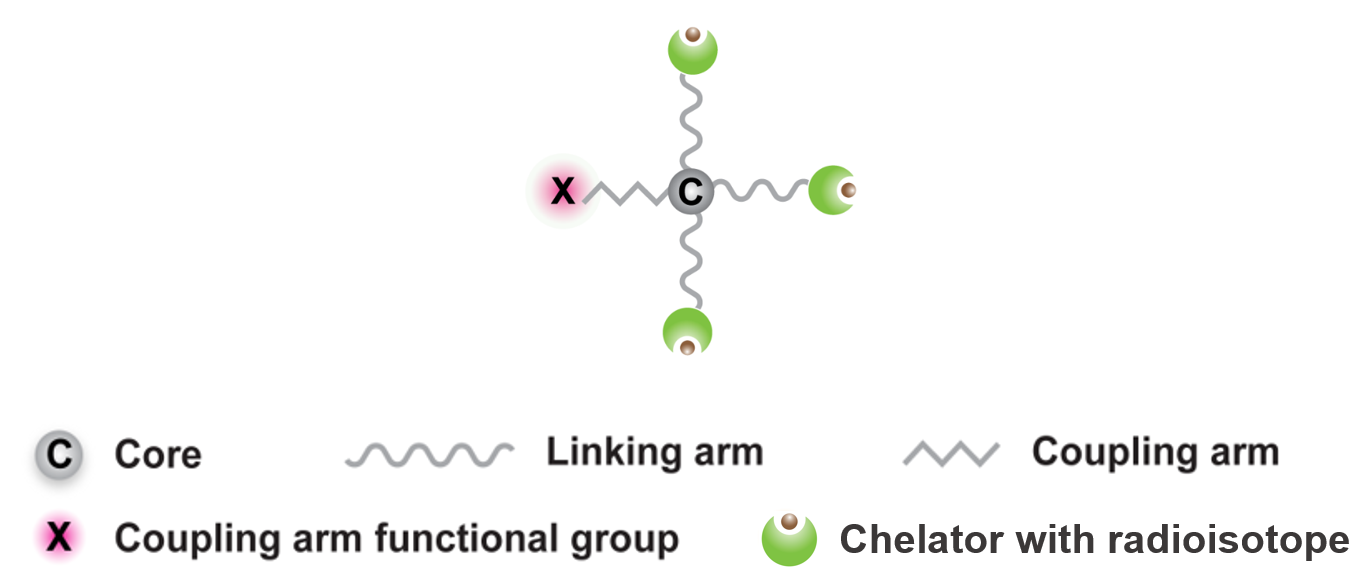
A chelator bundle is a packed multi-arm linker carrying multiple chelator groups, such as 1,4,7,10-tetraazacyclododecane-1,4,7,10-tetraacetic acid (DOTA), 2,2′,2”-(1,4,7-triazacyclononane-1,4,7-triyl) triacetic acid (NOTA), and diethylenetriaminepentaacetic acid (DTPA).
These chelator groups can bind to a range of cations, such as those of yttrium (Y), indium (In), gallium (Ga), zirconium (Zr), lutetium (Lu), etc. These elements exist in various radioactive nuclei, some of which have particle emissions and half-lives of decay at applicable ranges.
Typically, a maleimide group is installed at the end of coupling arm. A cluster of acidic amino acid residues may also be installed adjacent to the maleimide group. The cluster of negative charges of the chelators and of the acidic amino acid residues potentiate the maleimide group as an electrophile.
Here is an example of a chelator bundle.
When the chelator bundle is conjugated to a targeting moiety such as an antibody, the resulting product is an antibody–chelator conjugate that has not yet been loaded with a radionuclide. After manufacturing, this conjugate is transported to designated clinical-center laboratories, where the radionuclide loading (radiolabeling) step is performed.
Following radiolabeling, the final product is referred to as an antibody–radionuclide conjugate (ARC), which can be used for clinical diagnostic (imaging) and/or therapeutic applications.
The shipping of the radionuclide to the radiopharmacy and the timing of the loading reaction are tightly coordinated with the administration of the ARC to a patient, due to the short half-life of the radionuclide.
Here is an example of an antibody–chelator conjugate. (For detailed information, please refer to the T-E Meds website: https://www.temeds.com/ARC)
